Saturday, March 26, 2016

Sacagawea Art Gallery


I chose Lisa Englander’s watercolor from 1988 for my blog post.  I really like art, and have visited numerous museums over the years, and to be honest, this is not the type of art I usually enjoy.  I usually like art with softer colors, more blurred lines and more balanced.  Paul Cezanne’s landscapes (in particular, his forest scenes) have always been a favorite of mine. So, being drawn to this piece was unusual for me. 

I think what initially caught my eye with this is that it reminds me of the sheets of Origami paper I’ve used over the years.  I love Origami, and years ago, I helped a Japanese student with her English, and in return, she taught me Origami.  So, as I looked around the gallery, I thought, “Huh.  That looks like Origami paper!”  Therefore, throughout this post, I’m going to refer to these things as “sheets”!

The second fascinating aspect of this is that it’s a watercolor!  I’ve attempted watercolor, and I know JUST how tough it is to keep it from bleeding.  That could be my incredible lack of artistic talent, but it IS difficult.  There is very little bleeding in this piece.  It looks like acrylic or oil paint – except if you look closely, you can see some unevenness in color.  (Look at the lower left grey sheet.  You can see unevenness in the color in the lines.)  I thought that it was amazing that it was a watercolor!


Something that’s obvious about the piece is that it’s asymmetrical.  But not in a bad way.  It’s balanced with the bold and strong colors of the design and all the white negative space around it.  Personally, I think it’s appealing with all the sheets coming out of one corner.  If you look closely, you’ll also see that although the sheets look like they’re coming out of the lower right corner, the sides of that corner aren’t even.  The right side and bottom have gaps and aren’t aligned.  At first glance you think they are-but they’re not.  This is a great example of Principle 3: Balance in our text, WSINYE.  “Asymmetry, then, reveals two unequal sides if bisected.  Asymmetrical balance tends to be more visually exciting, or at least more visually interesting, than symmetrical balance.”  In my opinion, this asymmetry does make the piece more visually exciting and visually interesting!  The only thing that bothers me about it is that there is no border around the sheets; nothing “contains” them.  But that’s just a personal observation.

I also really liked the mix of patterns in the sheets. There are very geometric shapes in the majority of the sheets; checkerboard patterns, three dimensional and lines.  And then, in the center of the piece are sheets with, what looks like, flower patterns. The shape of these “sheets” don’t look square, either!  They almost look like fan shapes.  It looks like chaos within order.  And the crazy thing is that it works!  It seems balanced – and maybe it’s because it’s in the center of all the geometric designs.  In WSINYE, Element 3: Balance/Form talks about this. "In art lingo, we speak of two kinds of shapes-inorganic and organic.  Inorganic shapes and forms are precisely geometric, such as perfect circles, squares, rectangles, triangles, etc.  These don’t appear so much in nature so we say they’re inorganic.  Organic forms are more natural, as found in nature." Both organic and inorganic forms were used - and again, it works.

All in all, I really liked this piece.  The only problem I had with it was that I couldn’t figure out what it had to do with Sacagawea…

Saturday, March 19, 2016

Something I See (and use) Everyday


The “something” I see every day is my mechanical pencil.  I also use it every day.  I prefer pencil to pen because I can erase anything I don’t need.

I chose an object rather than a piece of art, a poster, or something obviously “visual”.  I love artwork.  I love color.  I love expression.  But when I was looking around for the item I was going to photograph, my eye kept going to my trusty pencil.  

Looking at my pencil, I can see that it has a bold, blue color.  It’s also clear plastic in spots so you can see the mechanical workings of the pencil.  That in itself is interesting.  Most mechanical pencils are solid color metal or plastic.  In the kind I prefer, I can see the inner mechanism for advancing the lead and even though the blue is bold, it also has some transparency to it and you can see the eraser portion as well.  I’m a bit of a geek (okay, a lot of geek), and this appeals to me.  It is also a 0.9mm lead pencil and you can see that the leads in the reservoir are thicker than a normal mechanical pencil.  I prefer bold lines, so I prefer thicker leads in a pencil.  I can also see that the rubber grip looks comfortable.

But even more than the actual pencil itself, the meaning I derive from it is so much more.  I can create visuals with that pencil.  I can’t really draw, but I do write.  And I could create entire worlds with that pencil if I wanted to.  More realistically, that pencil helps me think.  I can write out what’s in my mind and make sense of my thought process when I’m analyzing data at work.  Or trying to draft a sensitive letter.  Or brainstorming with coworkers on workflow changes.  At one point in my job, I was spearheading a project to get us onto our current computer system.  I put up a number of posterboards and sketched out the old workflows, and then the new ones with that pencil.  I encouraged other members of my department to add things to the posterboards.  In our text, White Space is Not Your Enemy, the authors talk about Fluent Thinking (p.16).  That pencil encouraged that Fluent Thinking!

There was something that really stood out to me in the Brian Kennedy Ted Talk.  At one point, he says, “I’ve been finding our text scholars saying, ‘Everything’s a text!’  And I’m equally imperious, because I’m saying, ‘Everything’s an image.’ “  And he’s right.  You can write anything you want, but if your audience cannot read, it’s meaningless.  I think of the illustrated manuscripts that came out of the middle ages.  They were beautiful pieces of art – and they were written text.  Poetry, stories and novels can create so much visual beauty by their actual words.  Words ARE images and can evoke powerful meaning and powerful emotions.

So, there’s the actual physical appearance of the pencil.  And then there is so much more meaning to what it is and what it is capable of.  Such a simple object with such infinite possibility. 

Wednesday, March 16, 2016

Jen P's Pet Peeve

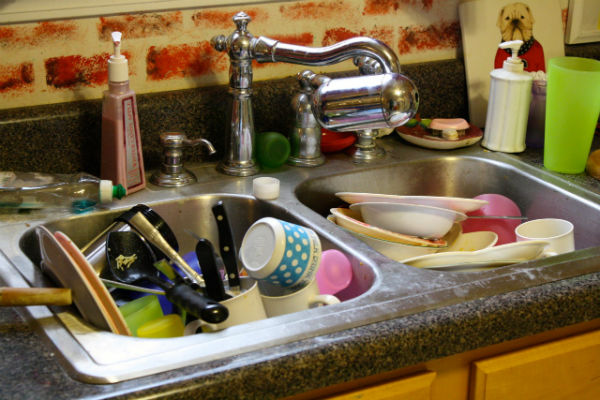
The pet peeve that immediately comes to mind is when I go to clean up the kitchen, there are dishes filling both sides of the sink.  What this means is that I have to actually clean out the sink before I can do any dishes or cleaning in the kitchen.  If one of the sinks was clean, I could just start!

But I can't - because the sink is cluttered with dishes!  This may seem really petty, but it irritates me.  I have to clean before I can clean.


Learn how to stop the madness!